

This is fascinating. No. It seriously is. Read on.
There are two feelings that AI gives me. Sometimes in the same afternoon.
The first one is dread. That quiet, low-level hum of what exactly am I for? It creeps in when you watch a machine do something in four minutes that you’d have spent four days on. When a client asks “can’t AI just do that?” and you realise, uncomfortably, that it probably can. When you open a research paper and it takes your breath away — not because it’s complicated, but because a computer wrote it.
Is there any point to me anymore? Haha!
The second feeling is the opposite. It’s the closest thing I’ve experienced to having actual superpowers. The day I realised I could build a functioning web app in an afternoon. The moment a piece of copy came back so close to right I barely touched it – ouch! But oh….. The workflow that used to take a week now takes a morning.
Same tool. Same week. Completely opposite feelings.
I’ve been sitting with that tension for a while now. And then I read something that helped.
An 80-year-old Math problem. Figured out by OpenAI in approx 32 hours. What they hey?
In 1946, a Hungarian mathematician named Paul Erdős posed a question. Simple to explain. Apparently impossible to resolve.
Draw some dots on a piece of paper. How many pairs of those dots can sit exactly one unit apart? Erdős worked out a clever grid construction that maximised the count. Then he made a conjecture — essentially, that his approach was the best anyone could do. That no configuration of dots could beat it.
Here’s why that matters — and why a 10-year-old actually gets this faster than most adults.
Imagine you’re at a birthday party. There are 20 kids in the backyard. You want to find out how many pairs of kids are standing exactly one metre apart. Easy enough with 20 kids. Now imagine a million kids. The question becomes what’s the smartest way to arrange them so the maximum number of pairs are standing exactly one metre apart?
Erdős worked out the cleverest arrangement. Then said — and this is the important bit — no arrangement can ever do better than this. That’s not just a maths claim. That’s a statement about the limits of the possible. He was drawing a line and saying nothing can cross it.
Every mathematician who came after him looked at that line and nodded. Made sense. Seemed right. So they spent their careers trying to prove the line was real — not wondering if maybe, just maybe, there was a gap in the fence.
That’s not a maths problem. That’s a people problem. Experts trust other experts. Nobody wants to be the one who wasted years chasing something the smartest person in the room already ruled out.
For 80 years, every mathematician who looked at this problem agreed with him. They spent their careers trying to prove Erdős right. Nobody seriously tried to prove him wrong. He was Erdős. You don’t walk into a seminar room and announce that one of the greatest mathematicians in history missed something obvious.
Last month, OpenAI fed the problem to a general-purpose reasoning model. Not a specialist maths AI. Not a system trained specifically on geometry. A general reasoner.
It disproved Erdős. Hundreds of pages of logic. A new construction using tools from algebraic number theory — a completely different branch of mathematics — mapped back down to the 2D plane. A result no human had ever attempted, using methods that had existed for decades.
The mathematicians who verified the proof were stunned. Fields medalist Tim Gowers called it “a milestone in AI mathematics.” He said if a human had submitted the same proof to the Annals of Mathematics, he’d have recommended acceptance without hesitation.
Jacob Tsimerman from the University of Toronto put it plainly —
“AIs have an edge — it’s not just that they can try all known methods. They can play for longer and in more treacherous waters than mathematicians without getting overwhelmed.”
And Harvard mathematician Melanie Matchett Wood said something that stopped me cold —
“If all the experts assembled after the fact had instead spent the same time seeking a counterexample, they would have found one. Maybe people should be spending more time playing devil’s advocate.”
Read that again.
The solution was always there. The tools existed. Nobody tried — not because they lacked the ability, but because they assumed the expert was right. Because the social cost of being wrong in public was too high. Because specialising in a field means inheriting all of its assumptions.
AI had none of that baggage. It just tried the thing.
OK but why does solving it actually matter?
Here’s the honest answer. On its own, this particular proof won’t change your life tomorrow.
But the type of problem it is — that matters everywhere.
The birthday party question is really asking, given a fixed group of things, what’s the smartest possible arrangement to maximise connections between them? That question shows up constantly. In how cities design mobile phone tower coverage. In how Spotify decides which songs sit close enough together in taste to recommend one after the other. In how Google maps the relationships between billions of web pages to decide which one is most relevant to you.
Every recommendation engine. Every ad targeting algorithm. Every “people you may know” feature on LinkedIn. All of them are versions of the same question Erdős was asking in 1946 — just with more dots, faster computers, and a lot more money on the line.
For 80 years, everyone assumed there was a ceiling on how well you could solve it. AI just proved the ceiling was wrong. Which means every system built on that assumption has room to get better.
That’s why mathematicians are excited. Not because of the dots. Because of what comes next.
I think.
Honestly, I have NFI.
I’m a digital marketer from Melbourne who got completely side-tracked down a maths rabbit hole at 11pm on a Sunday night.
All I know for certain is this — it’s a god dang pretty design. And when the news dropped, some of the smartest mathematicians on the planet had to have a Bex and a lie down.
That reaction alone tells you something important happened.
What this has to do with you and me
Pause for a second and think about the mathematicians. The ones who spent 40 years on a problem like this. Colleagues of Erdős. People who shaped entire fields. People who gave their careers to questions most of us couldn’t even read, let alone answer.
How do they feel right now?
I’m not being glib. It’s a real question. Because it’s the same question that accountants, lawyers, copywriters, developers, and designers are quietly asking themselves. What happens when the thing you spent decades mastering gets democratised in a Tuesday afternoon session with a chatbot?
I don’t have a clean answer. I’m not going to pretend I do.
But I do have a reframe. And it starts with something I used to think was a weakness.
Jack of all trades
For most of my career, I’ve known a little about a lot.
I’ve taught myself stuff I had no business knowing about.
WordPress. Marketing. Design. Copywriting. Automation. Hosting. Client management. Project delivery. A bit of code when I need it. Not enough of any one thing to call myself a specialist. Enough of all of them to make things work.
Traditional career advice hates this profile. Pick a lane. Go deep. Build expertise. The generalist is a threat to no one and valued by few.
I believed that for a long time. It felt like a character flaw dressed up as a career.
Then AI arrived and quietly inverted the whole argument.
Here’s the thing about prompting an AI well. You have to know enough about the output to judge whether it’s any good. A generalist does. The person who understands marketing and copy and design can look at what came back and know what’s missing. The specialist in one field gets a confident wrong answer and can’t always tell.
Think about making a film. The best director isn’t the best actor, the best camera operator, or the best screenwriter. The best director is the person who understands all three well enough to get the best out of each of them. They’re the translator. The conductor. The one holding the whole picture.
That’s not a specialist skill. That’s a generalist skill. And AI just made it the most valuable skill in the room.
What the mathematicians actually needed
Go back to the Erdős proof for a moment.
After the AI produced its result, five mathematicians with completely different specialisations had to verify and improve it. A number theorist. A combinatorialist. A geometer. A complexity theorist. Each one understood a different piece. Will Sawin at Princeton has already improved on the AI’s result.
None of them could have done it alone. But someone had to know enough about each domain to know who to call. To understand what the AI had actually done. To translate between the different mathematical languages in the room.
That’s not deep specialist knowledge. That’s the ability to hold the whole picture.
The AI didn’t replace the mathematicians. It handed them something none of them would have tried on their own. They had to synthesise it together.
That’s the model. That’s what working with AI actually looks like — not replacement, but a new kind of collaboration that rewards the person who can move between worlds.
The part where I admit the dread is still real
I’m not going to wrap this up with a bow and tell you it’s all fine.
Some of what AI does is genuinely confronting. There are things I used to charge for that I now use as prompts. Skills I spent years developing that a well-structured question can approximate in seconds. The ground shifts regularly, and there’s no pretending otherwise.
The dread comes back. Sometimes on a Monday. Sometimes mid-project.
But so does the other feeling. The superpowers one.
And increasingly I think the difference between the two — which one wins on any given Tuesday — comes down to how you’re positioned. The specialist asks can AI do what I do? That question has an increasingly uncomfortable answer.
The generalist asks what can I direct AI to do that I couldn’t do alone? That question keeps getting more interesting.
Now. About that image at the top of this post.
I’ve been looking for a hero artwork piece for my brick wall in my Fitzroy warehouse conversion for six months. Nothing has felt right. I kept looking at prints and installations and thinking close, but not quite.
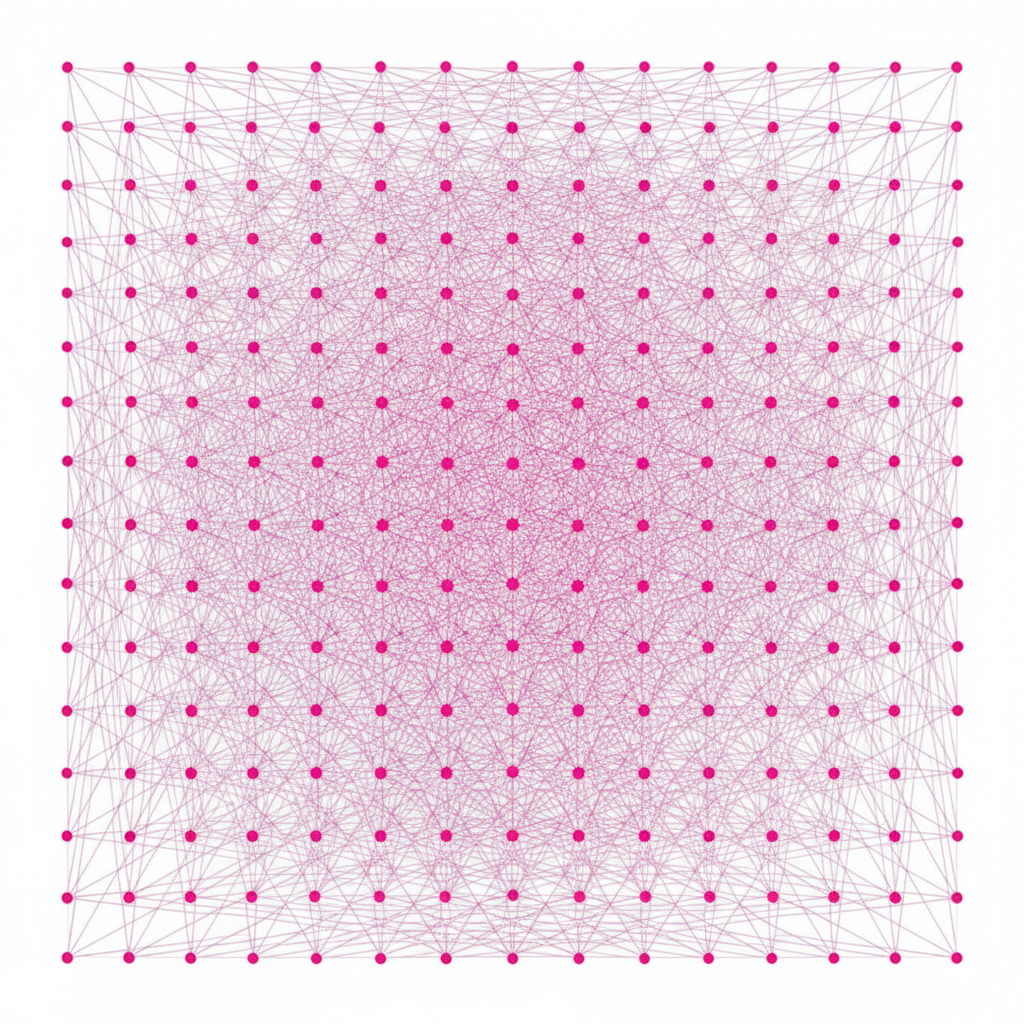
Last week, in the middle of reading about the Erdős proof, I saw what the AI’s solution actually looks like when you plot it.
I think I might have it printed on my wall. I could stare at this for hours. This represents so much about right now in the age of AI.
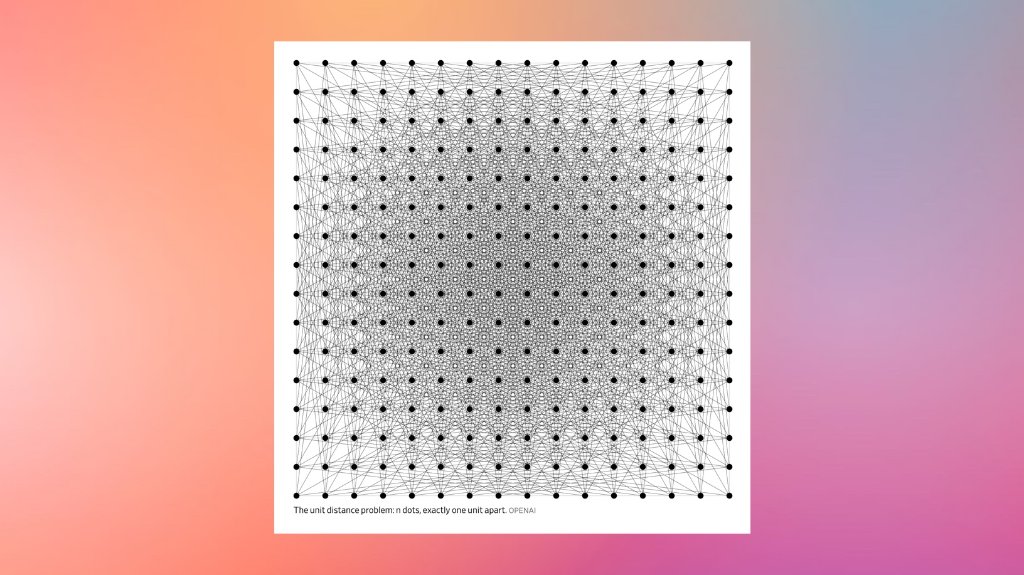
The unit distance problem — n dots, exactly one unit apart. Source: OpenAI — An OpenAI model has disproved a central conjecture in discrete geometry
That’s what a disproved 80-year-old conjecture looks like when you render it. A dot grid that took 80 years to produce. Beautiful, precise, and completely counterintuitive.
The same AI that makes you feel obsolete on a Tuesday can hand you the most beautiful thing you’ve ever put on your wall by Friday.
That’s the deal. Learn to work with it.
Frequently Asked Questions
What is the Erdos unit distance problem?
A geometry problem posed by mathematician Paul Erdos in 1946. Given n points on a plane, what’s the maximum number of pairs that can be exactly 1 unit apart? Erdos conjectured his grid construction was optimal. An OpenAI reasoning model disproved that conjecture in May 2026 — the first time AI autonomously resolved a prominent open problem in mathematics.
What does a generalist actually do in the age of AI?
A generalist acts as translator and conductor between AI tools, specialists, and client needs. They know enough about each domain to direct AI effectively, evaluate its outputs critically, and synthesise results across disciplines. That cross-domain fluency is increasingly rare and increasingly valuable.
Is AI replacing specialists or generalists faster?
Both, in different ways. AI can replicate narrow specialist tasks with impressive accuracy. But directing AI well — knowing which tool to use, how to prompt it, and whether what came back is right — requires broad contextual knowledge. That’s the generalist’s edge.
How can small business owners work with AI without losing their edge?
Stop asking what AI can do. Start asking what you can direct AI to do that you couldn’t do alone. The businesses winning with AI right now aren’t the ones who’ve handed over the wheel — they’re the ones using AI as a capable collaborator with a human in the director’s chair.
What is LoudCow?
LoudCow is a boutique digital agency based in Melbourne, Australia. We build AI-assisted WordPress websites and deploy AI sales agents for small and medium businesses. Founded by Catie Hughes — 15 years in digital, still learning something new every Sunday night.
Heads up — some links in this post are affiliate links. If you buy through them, I earn a small commission at no extra cost to you. Nuffin’s for free, right? This post was written by me, a human, after actual research and real tool-testing. AI helps me with the grunt work. The opinions are still mine.
Want this kind of setup for your business? Let’s talk →