
I’ve been stuck in a Loom billing loop for weeks. Not a bug report. Not a rant. A case study in why most “AI support” is just a wall with a chatbot sticker on it — and what the alternative actually looks like. And yes, this one’s all about AI customer service.
I wanted to cancel Loom.
Simple enough. I switched my video workflow to Descript — better editing, better transcripts, better fit for what I do. Loom was collecting dust. Time to go.
What followed was three weeks of billing confusion, two mystery charges, and a “you can’t delete your account” error that I have now seen so many times I could draw it from memory.
Here’s what happened. And why it matters way beyond my Loom subscription.
The “Release me From Your Subscription Claws” Downgrade That Wasn’t. AI customer service
I logged into Loom. Went to billing. Found the plan table.
The Starter plan — the free one — showed a button that said “Upgrade now.”
That’s confusing. Starter is below Business + AI. How is downgrading described as upgrading?
But fine. I clicked it.

The next screen said Downgrade to Loom Starter. $0.00 due today. Great. I confirmed.

Then I got a welcome email. “Welcome to your free 14-day trial.”
Odd. But I let it go.
Fourteen days later: charged again.
So I did it all again. Same button. Same confirmation screen. Same welcome email. Same charge fourteen days later.
Twice.
The Support That Wasn’t Support
I went looking for help.
Their support widget opened a chat. The chat was an AI. The AI sent me to their docs. The docs did not address a billing loop. The docs addressed general plan changes.
No email address. No ticket form. No human escalation path I could find.
Then — buried at the very bottom of a help article, in a font size that seemed deliberately designed to be ignored — I found a tiny Contact Support link.
I clicked it. Filled out a ticket. Finally felt like I was getting somewhere.
The reply came from an Atlassian bot. It said, in effect: we are experiencing high ticket volumes, here are some help articles in the meantime.
The help articles were the same ones the first bot had already sent me.
Two bots. Zero humans. Same loop.
Atlassian co-founder Scott Farquhar gave a speech about a year ago that genuinely excited me. His vision: AI tendrils into every part of your business. Bold. Ambitious. I was on board. But Loom is owned by Atlassian. And this is what that vision looks like in practice — two bots, the same loop, and a billing problem that never got solved.
I tried to delete my Atlassian account — Loom is owned by Atlassian — to cut the whole thing off at the root.

“Your account can’t be deleted because: User is last billing admin of a transaction account that has one or more active entitlements.”
Which I can’t cancel. Because I keep getting put back on a free trial. Which then converts to a paid plan. Which keeps the entitlement active.
Loop. Closed.
This Isn’t a Loom Problem. It’s an AI Support Problem.
Loom is not uniquely evil. This pattern is everywhere.
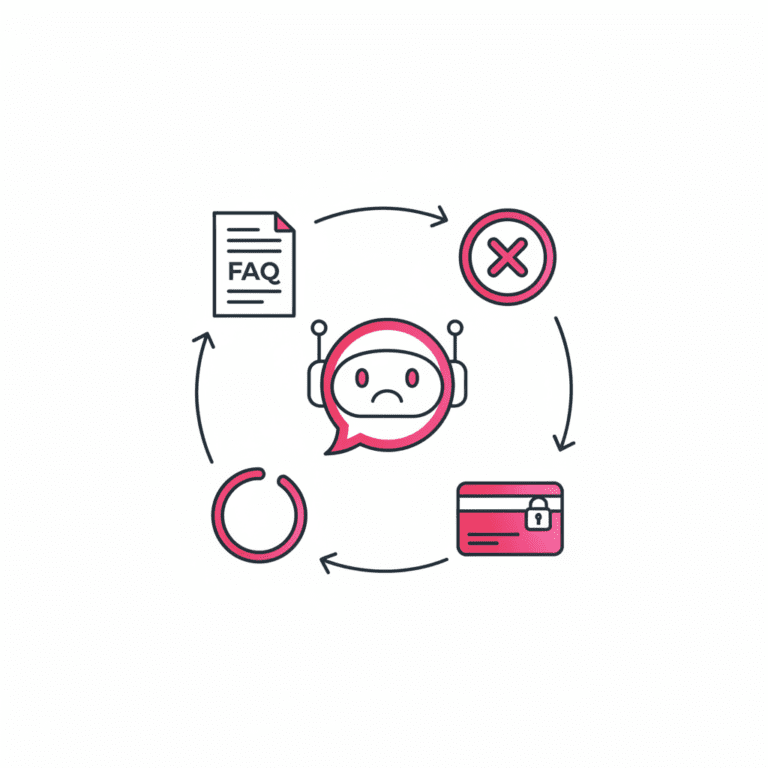
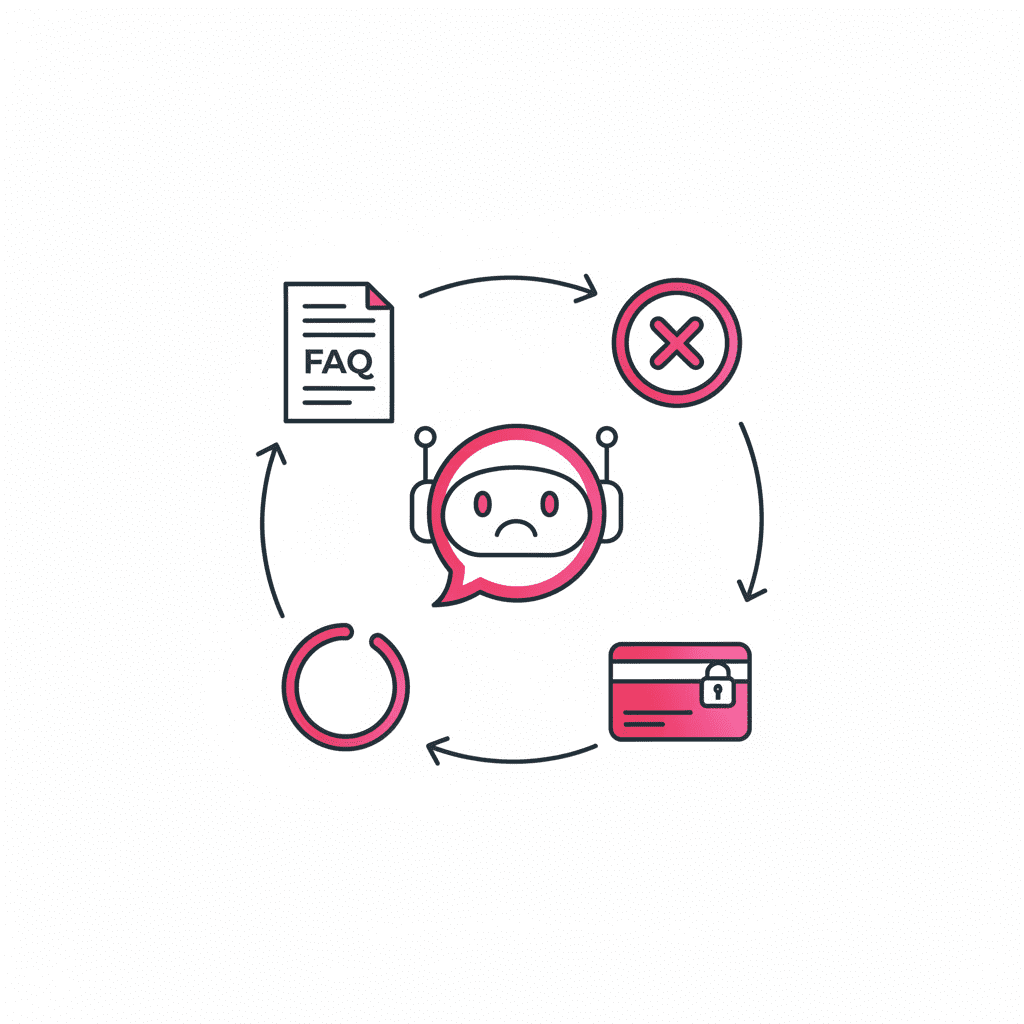
Companies bolt an AI chatbot onto their support surface. The bot handles FAQs. When it can’t help, it sends you to documentation. The documentation doesn’t cover edge cases. There is no escalation path.
The result isn’t support. It’s a wall with a friendly face on it.
And the edge cases — billing loops, cancellation errors, account ownership conflicts — are exactly the situations where people most need a human.
This is the difference between AI as a tool and AI as a barrier.
Google Already Knows This Is Broken
In April 2026, Google Cloud published their AI Agent Trends Report — surveying 3,466 enterprise decision-makers globally.
Trend #3 is called “Agents for Your Customers.”
The report describes concierge-style AI agents that know your history, anticipate problems, and resolve them before you have to complain. Their example: a logistics agent that detects a failed delivery at 3pm, reschedules it, applies a $10 credit, and texts the customer — without a human ever touching it.
That’s not a chatbot. That’s a system that actually knows what happened and can do something about it.
49% of enterprises with AI agents in production are using them for customer service. Danfoss cut their response time from 42 hours to near real-time.
The gap between that and “here’s a link to our docs” is enormous.
Good AI support is proactive. It knows your account. It understands the sequence of events. It has access to billing systems and can actually take action.
Bad AI support is a search bar in a chat bubble.
Meanwhile, I Made the Switch to Descript
While I was fighting Loom, I was also recording in Descript.
The difference in philosophy is visible immediately. Descript is built around editing video like a document — cut words, cut footage, overdub your voice. It’s a content creator’s tool, not a meeting recorder that grew up.
For anyone producing blog content with supporting video, tutorials, social clips, or voiceover — Descript is genuinely better. The transcript editing alone saves hours.
But this isn’t really a tools comparison post. The bigger point is this: I am now actively trying to leave Loom, and I cannot. That’s a product failure that has nothing to do with the core recording features.
If a customer wants to leave and they can’t — that’s not retention. That’s friction used as a trap.
Bad AI Support Starts With Bad Data
Here’s the thing most people miss when they “add AI to support.”
The AI can only be as good as what it’s trained on.
If your customer service documentation doesn’t cover billing loops, your AI can’t solve billing loops. If your system doesn’t have access to account history, your AI is guessing. If there’s no escalation protocol in the data, the bot has nowhere to go.
Input equals output.
Training a customer service agent is not slapping a chatbot on a help centre. It requires mapping every common failure mode. Every error state. Every billing edge case. Every escalation path. Every “the docs don’t cover this” scenario.
That takes real work. Real data. Real thinking about what actually breaks in your product.
The companies doing it well have invested in clean, structured, complete knowledge bases — and given their agents access to live account data. Not just articles.
The companies doing it badly have given their customers a search bar and called it AI support.
I know which one I was dealing with.
This Is Why Agent Training Is Specialist Work
When I set up an AI sales agent for a client, the first question I ask is: what does your customer data actually look like?
Not what products you sell. Not what your FAQ says. What does the actual journey of an actual customer look like — from first contact to complaint to resolution?
Because an agent trained on vague information gives vague answers. An agent with no escalation path creates the same loop I’m stuck in with Loom.
The Google report nails it. The agents that work are concierge-level. They know the customer. They have access to the right systems. They can actually resolve the problem.
That’s not a plug-in. That’s a build. And it has to be done properly.
Heads up: This post contains affiliate links. If you click through and buy, I may earn a commission — at no extra cost to you. I only recommend tools I’ve actually used. Nuffin’s for free.
Want this kind of setup — an AI agent that actually knows your customer and can do something about it? Let’s talk →
Frequently Asked Questions
Why doesn’t AI support actually help with billing issues?
Most AI support bots are trained on documentation, not live account data. They can answer common questions but can’t access billing systems, investigate transaction errors, or escalate to a human.
Is Descript better than Loom for small businesses?
Depends on what you need. Loom is quick to record and share. Descript is better for editing, transcripts, voiceover, and producing polished content. If you’re a content creator, Descript wins.
What does good AI customer service actually look like?
Concierge-level. The agent knows your account history, has access to live systems, and can take action — not just link to docs. 49% of enterprises are already deploying this, per Google’s 2026 AI Agent Trends Report.
How hard is it to train an AI customer service agent properly?
Harder than most businesses realise. You need clean, structured data covering every failure mode, edge case, and escalation path. Input equals output. Done properly, transformative. Done badly, it’s a wall.
Heads up — some links in this post are affiliate links. If you buy through them, I earn a small commission at no extra cost to you. Nuffin’s for free, right? This post was written by me, a human, after actual research and real tool-testing. AI helps me with the grunt work. The opinions are still mine.
Want this kind of setup for your business? Let’s talk →